 Email: sales@telsto.cn
 Telephone: 86-021-6221 2832
 LinkedIn
 Youtube

CPRI runs over both single-mode and multimode fiber. The right choice for an RRU-to-BBU link depends mainly on link distance and the transceiver at each end. Most FTTA deployments use single-mode, yet multimode still fits short runs. This FTTA CPRI cable guide frames single-mode vs multimode around distance limits, transceiver pairing, and fronthaul conditions.
Key Takeaways
- Choose single-mode fiber for long-distance CPRI links and multimode fiber for short, cost-sensitive runs.
- Match your fiber type to the transceivers at both ends to ensure a reliable connection.
- For outdoor FTTA sites, select hardened cables with ODC connectors and IP68 ratings to withstand harsh conditions.
What Is CPRI?
CPRI stands for Common Public Radio Interface. It is the standardized fronthaul link between the baseband unit and the radio equipment at the tower. The baseband unit, or BBU, handles signal processing at the base of the site. The remote radio unit, or RRU, converts digital data into radio signals at the antenna. An active antenna unit, or AAU, combines the radio and the antenna in one housing. CPRI carries digitized radio data between these endpoints.
CPRI in RRU-to-BBU Links
In nearly every real deployment, the CPRI link is a pair of single-mode fibers. One fiber carries traffic toward the tower. The other carries traffic back to the BBU. Duplex LC connectors are the typical interface on this indoor-side connection. The CPRI cable stays short and protected inside the equipment room or cabinet.
A CPRI link serves one RRU or one AAU in most cases. Each radio unit therefore needs its own fiber pair back to the BBU. This point-to-point layout keeps the fronthaul simple and predictable. It also explains why fiber counts at a site grow with the number of radio units.
Fiber as the CPRI Transport
Fiber is the standard transport for CPRI traffic. Copper cannot carry the data rate over useful distances. The fiber type matters for reach and for transceiver pairing. Single-mode fiber supports long runs with laser sources at 1310 or 1550 nm. Multimode fiber suits short runs at lower component cost.
An FTTA site extends this fiber path outdoors, from the base to the radio unit on the tower. The CPRI cable in that outdoor span needs hardening against weather and mechanical stress. Section two compares the two fiber types in detail.
Single-Mode vs Multimode for CPRI
Distance and Bandwidth
Link distance is the first filter in any single-mode vs multimode decision. Single-mode fiber carries CPRI traffic over 2 km to 80 km with the right optics, and a 1550 nm ZR module reaches the full 80 km. Multimode fiber suits short spans of a few hundred meters. Modal dispersion degrades the signal as distance grows, so multimode bandwidth tops out in the 1–10 Gbps range. Single-mode avoids that limit entirely. It handles tens of Gbps to Tbps and shows no modal dispersion penalty, which matters for high-volume 5G traffic.
| Fiber Type | Bandwidth Capability | Limiting Factor | Suitable Distance |
|---|---|---|---|
| Single-mode CPRI cable | High bandwidth at high speeds | No modal dispersion | Long distances, several kilometers |
| Multimode CPRI cable | Lower bandwidth needs | Modal dispersion | Short distances, a few hundred meters |
The fiber mode also sets the loss budget. A long fronthaul run on single-mode keeps signal quality stable across the span. A short in-building run on multimode performs well within its reach.
Transceiver Compatibility and Cost
The transceiver at each end must match the fiber type. Single-mode links use 1310 nm laser sources, including 1310 nm LR optics and 10G SFP+ DFB modules rated for 2 km, 10 km, 20 km, or 40 km. A 1550 nm SFP+ extends reach to 80 km. CWDM and DWDM variants add channel capacity at 40 km to 80 km. 25G SFP28 ER optics at 1310 nm cover up to 40 km and serve 5G CPRI and eCPRI fronthaul.
Multimode links pair with 850 nm SR modules over OM3/OM4 50/125 cable. The larger multimode core accepts looser alignment tolerances. That lowers component cost and simplifies field work, which makes multimode the practical pick for short, cost-sensitive runs.
One source claims CPRI does not support single-mode. Treat that as a minority view. Single-mode is the standard choice for CPRI fronthaul in practice, and OS2 9/125 cable is the norm for RRU-to-BBU spans. Multimode remains a sound option wherever the link stays short.
FTTA CPRI Cable Assembly Basics
Fiber, Connectors, and Jacketing
An outdoor CPRI cable assembly must survive weather, vibration, and repeated handling. The Telsto Outdoor Waterproof Fiber Optic CPRI Patch Cord meets these demands with ODC connectors. ODC has become the standard interface for 3G, 4G, and WiMax base stations and for FTTA sites. A screwed locking mechanism holds the connection secure. A guide structure supports blind installation, which saves time on the tower. A protective cap shields the end face, and a wall sealing design keeps the seal tight where the cable passes through a wall.
The assembly comes in single-mode or multimode fiber, with 2-core or 4-core counts and 5.0 mm or 7.0 mm diameters. Optical performance stays tight across the range.
A typical specification is an insertion loss of ≤0.30 dB and return loss of ≥60 dB (APC), with end-face quality inspected to IEC 61300-3-35.
Parameter Single Mode Multimode Insertion Loss Typical ≤0.15 dB; Max ≤0.30 dB Typical ≤0.15 dB; Max ≤0.30 dB Return Loss ≥60 dB (APC); ≥50 dB (UPC) ≥30 dB (UPC)
Indoor CPRI links usually use duplex LC connectors. Outdoor FTTA links need hardened ODC interfaces instead. The fiber type must match the transceiver at the BBU and the RRU.
Outdoor Deployment Considerations
Environmental ratings separate an outdoor CPRI cable from an indoor patch cord. The Telsto assembly carries IP68 protection and passes salt mist, vibration, and shock tests. It operates from -40°C to 75°C. The ODC plug withstands tensile loads up to 800N.
- Outdoor connectors such as ODC, FullAXS, and ODVA are rated IP65 to IP68 depending on series.
- UV-resistant jackets must withstand vibration, icing, and temperature cycling at cell sites.
- Outdoor cables carry greater tensile strength than indoor cables, which have lower tensile strength and less protective coating.
These requirements protect the fronthaul path through years of exposure. Specify the full CPRI cable assembly against them before ordering.
CPRI Fiber in FTTA
Typical RRU-to-BBU Architectures
The FTTA fronthaul path runs from the BBU or distributed unit at the base to the remote radio unit or AAU at the tower top. A hardened outdoor patch cord carries that span. Most tower runs stay short, and the loss budget sits in the connectors rather than the glass.
| Deployment aspect | Typical RRU–BBU distance | Notes |
|---|---|---|
| Fronthaul routing (tower + shelter) | 50–150 m | Single-mode fiber with suitable transceivers covers this with ample margin; connector loss budget is the limiting factor, not distance |
| Tower runs with single-mode jumpers | 50–150 m | Routine, with margin to spare; loss budget resides in connections, not the fiber glass |
At these spans, the fiber type rarely limits the CPRI link. Connector quality and assembly workmanship drive performance instead. That is why outdoor FTTA deployments place such weight on hardened ODC terminations and tested insertion loss.
C-RAN and Centralized RAN Scenarios
Centralized RAN changes the distance picture. BBU functions are pooled across dispersed sites, and the fronthaul network connects each radio unit to that pool. Link distance becomes a direct design consequence of how far the radios sit from the pooled BBU sites.
- Each RU connects to the centralized BBU pool through a dedicated fiber link, traditionally CPRI, needing high bandwidth and low latency — roughly 9 Gbps per RU for 100 MHz 5G spectrum.
- BBU processing must finish within a <3 ms round trip from the RU, which caps fronthaul distance at approximately 30 km.
Those longer spans push base station fronthaul planning toward single-mode. Multimode fiber cannot cover them. For short in-building runs, multimode remains viable. A well-specified FTTA CPRI cable keeps either choice reliable.
CPRI vs eCPRI
CPRI and eCPRI split the radio stack at different points. CPRI splits below the PHY layer and transports all IQ samples raw. The channel bandwidth must be pre-defined, and it cannot adjust to real-time traffic loading. This makes CPRI bandwidth and delays predictable and precise, yet inflexible. eCPRI moves the split point higher, so some baseband processing happens in the RRU before transmission.
How eCPRI Changes Bandwidth Needs
The packet-based approach of eCPRI substantially lowers fronthaul bandwidth needs. A commonly cited figure puts eCPRI at roughly one-tenth of what CPRI would require under comparable conditions. Higher functional splits push the reduction further.
| Scenario | CPRI Bandwidth | eCPRI Bandwidth |
|---|---|---|
| 5G massive MIMO, 64TRX, 100 MHz cell | Over 150 Gbit/s | ~10–25 Gbit/s (split 7-2) |
| General fronthaul reduction | Baseline (all IQ samples raw) | 5–15x lower via higher splits |
5G massive MIMO, wide carriers, and many antenna ports exceed practical CPRI capacity. eCPRI brings those links back within reach.
Fiber Type Implications
The practical effect on fiber choice is modest. Single-mode remains the forward-looking default for longer, higher-capacity links. Multimode fiber stays viable for short in-building runs. Either fiber type can carry an eCPRI fronthaul link when the transceivers match.
Plan the CPRI cable and the eCPRI cable around the same rules. Measure the span from the BBU to the RRU, confirm the optics at both ends, then select the assembly. A hardened outdoor CPRI cable with ODC terminations serves an FTTA site under either protocol.
Fiber Selection Guide
Matching Distance and Transceivers
Fiber selection follows a fixed sequence. Work through these steps before any order is placed.
- Measure the physical link distance from the BBU to the RRU, including the tower climb and any slack loops.
- Confirm the wavelength and rated reach of the transceiver at each end.
- Match the fiber type and wavelength to that reach, then choose single-mode or multimode to suit.
Distance drives the decision. Single-mode suits spans beyond a few hundred meters and outdoor carrier-grade sites. Multimode fiber fits short runs inside one equipment room or a brief in-building path. An outdoor FTTA site with the BBU at ground level and the RRU on the tower falls firmly into the single-mode camp.
The OMCCable article on CPRI fiber corroborates this: single-mode fibers are typically preferred for long-distance transmissions, while multi-mode fibers may be used in shorter, localized networks, since fiber type selection influences achievable transmission distances and data rates.
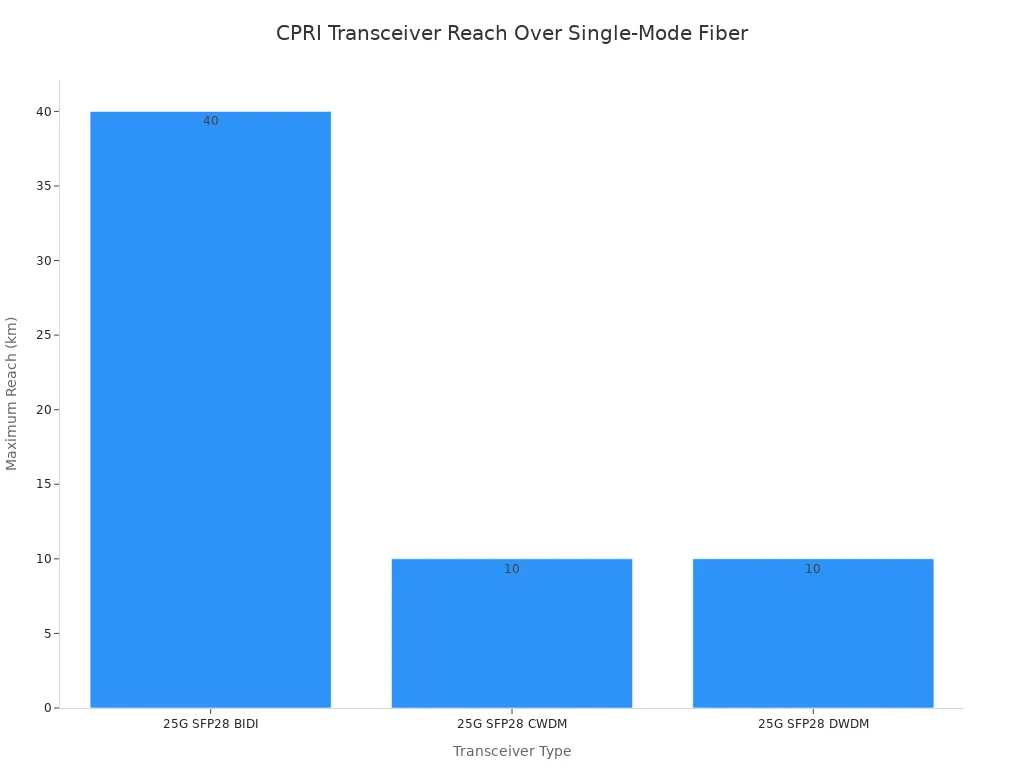
Transceiver reach sets the ceiling. The table below lists published reaches for common 25G modules over OS2 single-mode fiber.
| CPRI Transceiver Type | Fiber Type | Interface | Max Reach |
|---|---|---|---|
| 25G SFP28 BIDI (1270nm-Tx/1330nm-Rx) | Single-mode (OS2) | Simplex LC | Up to 40 km |
| 25G SFP28 CWDM (1470–1570nm) | Single-mode (OS2) | Duplex LC | Up to 10 km |
| 25G SFP28 DWDM (C18–C61) | Single-mode (OS2) | Duplex LC | Up to 10 km |
Verifying Link Budget and Loss
A matched fiber type and wavelength still fails if the loss budget is tight. Add every loss element along the path before ordering a CPRI cable assembly. Count the connector insertion loss at both ends, splice losses, and the fiber attenuation over the full run. Compare the total against the transceiver's published budget.
Connector quality deserves close attention. The Telsto outdoor CPRI cable holds insertion loss to ≤0.3 dB for single-mode and ≤0.25 dB for multimode, with return loss of ≥45 dB for single-mode. These figures leave healthy margin on a typical tower run of 50–150 m, where connector loss dominates.
Return loss matters as much as insertion loss. A poor return loss reflects light back into the laser and destabilizes the signal. Verify both values on the datasheet for every CPRI cable in the fronthaul path. Request test reports with the shipment, then confirm the numbers against the link budget before installation begins.
Common Mistakes
Mismatched Fiber and Transceivers
The most common error is pairing the wrong fiber with the optics at each end. A multimode fiber strand joined to a single-mode transceiver will not carry the link, and the reverse fails just as surely. The wavelength and core size must agree on both sides of the cpri link. Check the transceiver label before the cpri cable leaves the warehouse.
A second mistake treats an indoor assembly as an outdoor one. Duplex LC patch cords suit equipment rooms, not tower mounts. An outdoor FTTA span needs hardened ODC terminations with a screwed locking mechanism and a protective cap. Assuming an indoor cpri cable assembly will survive weather invites water ingress and signal loss.
Overlooking Environmental Factors
Specifiers often ignore the IP rating, the temperature range, and the tensile load. An outdoor cpri cable assembly must hold IP68 protection against dust and water. The Telsto assembly also passes salt mist, vibration, and shock tests. Its operating range runs from -40°C to 75°C, and the ODC plug withstands tensile loads up to 800N.
These figures matter at the tower top. Wind, ice, and repeated handling stress every connection. A cpri cable rated for indoor use has lower tensile strength and less protective coating. Confirm the environmental ratings on the datasheet before ordering. The fiber type and the transceiver pairing decide the optical link. The environmental ratings decide whether that link survives its first winter.
Order the decision: link distance first, transceiver type second, environmental and installation conditions last. Single-mode fits longer fronthaul runs, C-RAN, and future capacity. Multimode suits short, cost-sensitive runs. Verify the full link budget and BBU transceiver pairing before ordering any ftta cpri cable. Confirm IP68, ODC, and temperature ratings for outdoor FTTA. eCPRI will keep reshaping fiber planning; revisit CPRI choices as networks evolve.
FAQ
Does a short tower run ever justify multimode?
Yes, when the span stays within a few hundred meters and the optics are 850 nm SR modules. Multimode lowers component cost on short, localized links. Most ftta sites still standardize on single-mode for consistency.
Which connector suits an outdoor CPRI link?
Hardened ODC terminations, not duplex LC. ODC adds a screwed locking mechanism, blind installation, and IP68 sealing. The Telsto cpri cable assembly also tolerates -40°C to 75°C and 800N of plug tensile load.
Will eCPRI change my fiber choice?
Rarely. Lower fronthaul bandwidth needs ease the optics budget, not the fiber type. Single-mode stays the default for long or high-capacity spans. Multimode remains practical for short in-building runs.
Post time: Oct-20-2026


