 Email: sales@telsto.cn
 Telephone: 86-021-6221 2832
 LinkedIn
 Youtube

Width, length, and coating are the three specifications that decide whether a PVC Coated Cable Tie performs reliably in a cable tray. Bundle weight and diameter, tray size and tie spacing, plus environmental and compliance conditions drive each choice. Cable tie size is commonly written as length x width, so both dimensions matter together.
Key Takeaways
- Choose the narrowest width that meets load and vibration needs to save material and protect cables.
- Measure the largest bundle diameter and add extra length for the locking head and tray geometry.
- Match the PVC coating to the environment and check ROHS compliance for regulated projects.
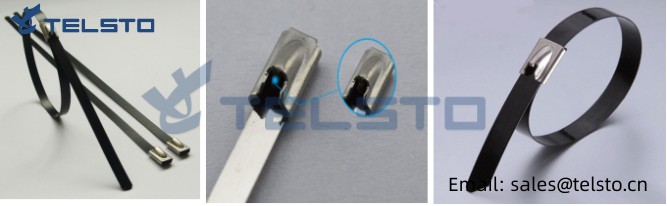
Specifying PVC Coated Cable Tie Width
Width is the band width of the tie, measured across the strap. This dimension is closely tied to tie strength. Typical products run from light-duty to heavy-duty, and Telsto offers 4.6 mm, 7.9 mm, 12.7 mm, and 15 mm options with tensile strengths up to 337 lbs (152 kg). A wider band carries more stainless steel, so it resists pull and cut far better than a narrow one.
Matching Width to Load and Tensile Strength
Start with the load and vibration conditions of the tray run. Heavier bundles and vibration-prone runs call for wider bands. A tray filled with large power cables places a steady static load on every tie. A run near motors, transformers, or moving equipment adds cyclic stress on top of that load. In both cases, a wider PVC Coated Cable Tie gives the locking head and band more material to share the force. Light bundles in a quiet, static run do not need that reserve. A narrow band holds them securely and keeps the installation compact.
Width, Bundle Fit, and Cable Protection
Width also shapes how the tie sits on the bundle and how well it protects the cable jacket. A wider band spreads pressure across a larger contact area. This spread reduces the chance of jacket damage when the tie is tensioned firmly. Narrow bands concentrate force on a small strip, which suits small, light bundles with robust jackets. Wide bands suit large bundles, soft-jacketed cables, and any point where the tie must clamp hard. The table below summarizes where each width fits best.
| Width | Typical Fit |
|---|---|
| 4.6 mm | Light bundles, short spans, low vibration |
| 7.9 mm | General tray runs, medium bundles |
| 12.7 mm | Heavy bundles, vibration-prone runs |
| 15 mm | Maximum load, large tray fills |
Match the band to the bundle, not to habit. A narrow tie on a heavy bundle can creep or cut the jacket. An oversized band on a small bundle wastes material and can leave slack. Choose the narrowest width that meets the load and vibration demand, then confirm the jacket protection is adequate. This balanced approach keeps every PVC Coated Cable Tie working within its design range.
Specifying PVC Coated Cable Tie Length
Length is measured from the head to the end of the tail. This dimension sets the maximum bundle diameter the tie can close around. Telsto lengths range from 150 mm to 1000 mm and accommodate bundle diameters up to 206 mm.
Sizing Length to Bundle Diameter
The practical method starts with the bundle. Measure or estimate the outside diameter of the cable bundle at its thickest point. Use that diameter to find the minimum required length. Then add take-up for the locking head. The head consumes part of the strap, so a tie cut exactly to the bundle circumference will not close. A small margin also lets the installer pull the tail through by hand or with a tensioning tool.
Estimate on the generous side when the bundle is irregular. Cables rarely form a perfect circle, and a bundle with mixed cable sizes bulges in places. A PVC Coated Cable Tie that only just reaches around a nominal diameter may fail to lock on the real bundle. Confirm the chosen length against the published bundle diameter range before ordering.
Length, Tray Dimensions, and Tie Spacing
Tray geometry shapes the length choice as much as the bundle does. A deep tray filled with several layers of cable produces a larger effective bundle than a single layer. Long runs also matter. Installers often need extra tail length to reach around the bundle and pull the tie tight from an awkward angle.
Tie spacing interacts with length in a simple way. Closer spacing shortens the unsupported span between ties, so each tie carries less load. Wider spacing shifts more load onto each tie and rewards a longer, more secure wrap. Plan spacing along the run first, then size the tie to the bundle and tray fill at each support point.
Selecting the PVC Coated Cable Tie Coating
The coating is the outer layer of a PVC Coated Cable Tie, and it does more than cover the metal. The PVC jacket adds abrasion and corrosion protection. It provides electrical insulation at the bundle surface. It also prevents galvanic corrosion when the tie contacts dissimilar metals, such as aluminum tray sections or copper conductors. Beneath the coating, Telsto ties use 304 or 316 stainless steel cores. These cores resist corrosion, vibration, weathering, radiation, and temperature extremes. The coating and the core work as a pair. The PVC handles surface wear and electrical isolation, and the stainless steel carries the tensile load. The insulation layer also separates the bundle from the tray metal, which reduces the risk of stray contact in electrical runs.
Environmental Resistance and Cable Protection
Match the coating to the environment. Outdoor installations face sunlight, rain, and temperature swings. The PVC jacket shields the stainless core from moisture and surface wear, and the core keeps its strength through weather cycles. Marine settings add salt spray. Here the 316 core offers better chloride resistance than 304, and the coating keeps salt away from the metal beneath. Industrial settings bring abrasion from vibration, contact with machinery, and occasional chemical exposure. An intact PVC layer absorbs that wear and protects the cable jacket at the same time. Soft cable jackets benefit most, because the coating creates a smooth, rounded contact surface instead of a bare metal edge. Radiation exposure, common near certain industrial equipment, is another reason the stainless core sits under a protective layer.
Inspect the coating at each tie point during installation. A nick or cut in the PVC exposes the core and creates a corrosion site. Route ties so the band does not rub against sharp tray edges. Keep tension within the range the coating can bear, since over-tensioning can stretch or split the jacket at the locking head. Coating color can aid inspection, since a bright jacket makes cuts and abrasion easier to spot during walkdowns. These simple steps extend service life in every environment.
Compliance, Compatibility, and Cost Fit
Compliance matters for regulated projects. Telsto ties are certified to ROHS standards, which supports use in electrical and telecommunications work with environmental requirements. Confirm the certification matches the project specification before ordering. Compatibility deserves a check as well. Verify that the PVC coating suits the cable jacket material and the expected temperature range of the run.
Cost fit follows protection needs. The coating choice should balance the protection the environment demands against the budget available. Standard PVC coating suits most indoor and sheltered outdoor tray runs. Harsher settings justify the added cost of a 316 core. Neither option is universally better. Each fits its own service conditions, and the right choice depends on the exposure the tray run will actually see. A specification that overstates the environment wastes budget, and one that understates it invites premature failure. Document the chosen coating and core grade on the specification sheet, so future maintenance orders the same combination.
Width follows load and tensile strength. Length follows bundle diameter plus tray geometry. Coating follows environment and compliance. Apply this checklist during specification:
- Confirm bundle weight and vibration.
- Measure the largest bundle diameter.
- Match coating to exposure and ROHS requirements.
Balancing these three specifications against cost delivers secure, reliable cable management in cable trays.
FAQ
Q: How do I measure bundle diameter for tie selection?
Wrap a soft tape around the thickest point of the bundle. Record that circumference, then divide by pi to get the diameter. Compare the result against the published bundle range of the tie.
Q: Does the PVC coating reduce the tie’s load capacity?
The stainless steel core carries the tensile load. The coating adds abrasion protection and insulation without changing the rated strength. Select width and core grade for the load, then confirm the coating suits the environment.
Q: How do I confirm ROHS compliance for a project?
Request the certification documentation from the supplier before ordering. Verify the certificate covers the exact product and coating combination specified. File the record with the project submittals for future maintenance orders.
Post time: Nov-18-2026


