 Email: sales@telsto.cn
 Telephone: 86-021-6221 2832
 LinkedIn
 Youtube

★ Key Takeaways
- • Match the coating to the installation environment. Epoxy handles heat, chemicals, and sunlight. PVC suits moderate indoor settings.
- • Verify performance with supplier documents. Check temperature ratings, chemical resistance, UV durability, and steel grade.
- • Compare total cost over the expected service life. A cheaper coating may fail early and cost more in replacements.
Epoxy Coated vs PVC Coated vs Uncoated Stainless Steel Cable Ties
Why the Coating Choice Matters
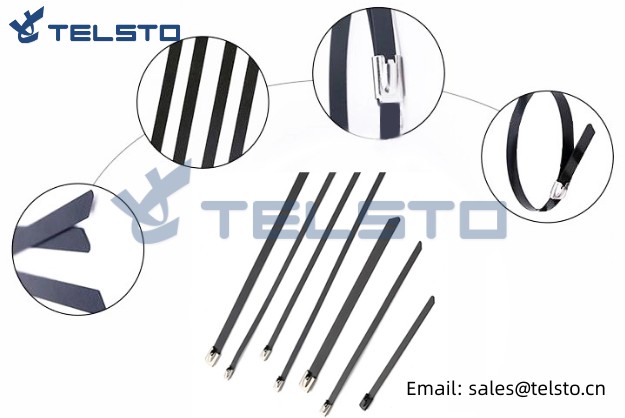
The comparison of epoxy coated vs pvc coated vs uncoated stainless steel cable ties begins with a simple question: what does the installation demand? Coated ties serve two practical purposes. First, the coating prevents sharp metal edges from scratching sensitive cable insulation during bundling. Second, it provides a dielectric barrier where electrical isolation is required. Uncoated stainless steel cable ties remain the reference point for raw strength, and they suit applications where bare metal performance is acceptable.
Each coating type fits a distinct role. PVC forms a continuous barrier against moisture, salt spray, and weak acids. Epoxy adds a harder shell suited to abrasion and harsh exposure. Neither option is superior in every case. A PVC coated tie performs well in moderate indoor settings, while an epoxy coated tie earns its place in aggressive environments. Buyers should treat both as fit-for-purpose solutions and match them to the job.
The coating protects the stainless steel beneath. It does not replace the metal’s strength. Buyers must therefore confirm the base stainless steel grade and the coating integrity together. A premium coating on a low-grade substrate delivers poor long-term results. The same logic applies in reverse. A high-grade substrate with a thin or poorly bonded coating will fail early under harsh conditions.
Uncoated Stainless Steel Cable Ties as the Baseline
Uncoated 316 stainless steel cable ties set the performance benchmark. Grade 316 offers strong corrosion resistance, and it handles marine and chemical exposure well without any added layer. Buyers who compare coated stainless steel cable ties against this baseline gain a clear view of what the coating adds and what it costs.
The 316 stainless steel substrate delivers tensile strength and durability on its own. A coating adds edge protection, a dielectric layer, and in some cases color coding for identification. These benefits matter in specific settings. Sensitive cable jackets, dissimilar metal contact, and electrical isolation all call for a protective layer. General bundling in dry, sheltered locations often needs no coating at all.
Buyers should also weigh the practical trade-offs. An uncoated 316 stainless steel tie exposes bare metal edges, and those edges can abrade soft insulation over time. A coated tie solves this problem but adds a layer that may wear, chalk, or degrade under certain exposures. The right choice depends on the cable, the environment, and the service life expected. Verification of both the stainless steel grade and the coating specification gives buyers the confidence to select correctly.
Temperature Range of an Epoxy Coated Cable Tie
Verifying the Temperature Range of an Epoxy Coated Stainless Steel Cable Tie
Temperature is a verify-with-supplier item. Buyers should request documented working ranges from the manufacturer rather than assume a figure from a catalog photo or a competitor’s sheet. The temperature range of an epoxy coated stainless steel cable tie depends on the coating chemistry, the cure process, and the base metal beneath it. Those variables differ between suppliers.
PVC Limits by Comparison
The temperature range of a pvc coated stainless steel cable tie sits well below the epoxy ceiling. PVC softens at a substantially lower temperature, so the practical upper limit is narrower. That constraint suits moderate indoor settings fine. Heat-intensive installations call for a different coating.
Chemical Resistance: What to Check
Chemical resistance verification starts with the exposure list. Buyers should confirm performance against moisture, salt spray, weak acids, acetic acid, alkali, sulfuric acid, solvents, and fuels. Each medium stresses a coating differently. A tie that survives one exposure may fail another.
PVC Barrier Performance
PVC coated stainless steel cable ties form a continuous barrier against moisture, salt spray, and weak acids. The soft layer seals the metal from splashes and humid air. This fit suits indoor plants, food handling areas, and sheltered bundling.
Epoxy in Harsh Environments
Epoxy coated stainless steel cable ties are typically specified for offshore, marine, and chloride-rich environments. The harder shell resists acetic acid, alkali, and sulfuric acid exposure.
UV Durability and Outdoor Exposure
PVC and Sunlight Limits
PVC is the least UV-stable of the three options: epoxy coated, pvc coated, and uncoated stainless steel. Sunlight breaks down the PVC layer over time. The material stiffens, cracks, and loses its grip on the metal beneath. For this reason, pvc coated stainless steel cable ties are usually reserved for applications where UV exposure is limited.
Cable Tie Epoxy Coating Outdoors
An epoxy coated tie provides UV protection, and the cable tie expoy coating resists sunlight far better than PVC. The shell will still chalk and fade over multiple years of direct sun. Chalking is surface wear, not sudden failure. The coating remains durable, but it is not permanent.
Mechanical Strength and Abrasion
Cut-Through and Impact
The coating adds edge protection and abrasion resistance. It does not add tensile strength. That strength comes from the stainless steel beneath. Buyers should verify the stainless steel grade (201, 304, or 316) alongside the coating type. A hard coating on a weak substrate will not hold a heavy bundle.
Cost and Application Fit
Comparing Installed Cost
Epoxy-coated ties generally cost more than standard stainless steel ties. The added protective coating accounts for much of the difference. PVC typically sits at a lower price point. Buyers should frame cost against service life and environment, not price alone. A low unit price means little when the coating fails in the first season.
Buyer Verification Checklist
Documents to Request
- Documented working temperature range for the exact part number
- Chemical resistance data for each expected medium, concentration, and temperature
- UV exposure rating and outdoor service guidance
- Tensile strength figures tied to the stainless steel grade
- Coating thickness and adhesion test results
- Base steel certification for grade 201, 304, or 316
Final Checks Before Ordering
| Dimension | PVC Coated | Epoxy Coated | Uncoated 316 |
|---|---|---|---|
| Temperature | Narrower practical ceiling | Higher heat fit | Grade-dependent, no polymer limit |
| Chemical resistance | Moisture, salt spray, weak acids | Marine, offshore, harsh chemicals | Strong base resistance, no barrier layer |
| UV durability | Least UV-stable | Chalks and fades over years | Fully sun-stable |
| Mechanical | Flexible, cushions impact | Hard, abrasion-resistant shell | Raw strength, bare edges |
| Cost | Lower price point | Higher due to added layer | Baseline price |
Verify five items against the real installation: temperature rating, chemical exposure, UV conditions, mechanical demands, and total cost. The coating protects the stainless steel; it never replaces its strength. Documentation should confirm both. Match the coating to the environment first, then verify cost, documentation, and availability. Uncoated 316 stainless steel remains the baseline for stainless steel cable ties, and every coating choice should be measured against it.
FAQ
Q: Which coating suits a coastal installation?
Epoxy is the stronger fit for salt spray and chloride exposure. PVC works in sheltered coastal cabinets with limited sunlight. Confirm the base steel grade alongside the coating before ordering.
Q: How do buyers confirm a coating will last outdoors?
Request UV exposure data and outdoor service guidance from the supplier. Epoxy resists sunlight well but will chalk over years. PVC suits shaded or indoor runs only.
Q: Does the coating change the tie’s strength?
No. Tensile strength comes from the stainless steel cable ties beneath the coating. Verify the steel grade and coating adhesion together, then compare total cost across the expected service life.
Post time: Nov-18-2026


