 Email: sales@telsto.cn
 Telephone: 86-021-6221 2832
 LinkedIn
 Youtube
In RF systems, cable selection is not only about impedance and signal loss. Mechanical flexibility can also affect installation quality, routing efficiency, connector stress, and long-term reliability.
This is especially important in telecom base stations, distributed antenna systems, equipment cabinets, antenna connections, and short RF jumper assemblies where space can be limited and cable routing may involve multiple bends.
Both flexible coaxial cable and superflexible coaxial cable are widely used in 50-ohm RF systems, but they are designed for different installation priorities.
Flexible cable generally provides a balance between RF performance, mechanical stability, and routing capability. Superflexible cable is designed to provide a smaller bend radius and easier installation where space is restricted or the cable must follow a more complex path.
Understanding the difference helps engineers and purchasing teams select the right cable instead of assuming that the more flexible option is always the better choice.
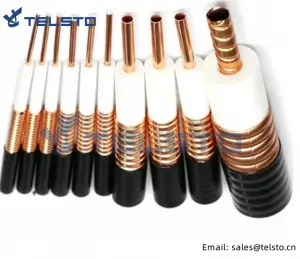
What Is a Flexible RF Coaxial Cable?
A flexible RF coaxial cable is a 50-ohm transmission cable designed to carry RF signals while providing enough mechanical flexibility for practical field installation.
Compared with rigid or semi-rigid transmission lines, flexible feeder cables can be routed through telecom sites, equipment rooms, towers, DAS installations, and other RF environments with fewer installation constraints.
Typical flexible cable construction includes:
- Inner conductor
- Foam polyethylene dielectric
- Corrugated or otherwise formed outer conductor
- Protective outer jacket
The exact construction depends on cable size and manufacturer.
Telsto offers 50-ohm flexible coaxial feeder cable solutions in multiple sizes for telecommunications, cellular base stations, distributed antenna systems, two-way radio systems, broadcasting, and other RF applications.
Flexible feeder cable is particularly suitable when the installation path is relatively predictable and there is enough space to maintain the required bend radius.
Its mechanical structure generally provides a practical balance between:
- RF transmission performance
- Mechanical strength
- Installation flexibility
- Long-run feeder capability
- Connector compatibility
For many conventional feeder routes, this balance makes flexible cable a practical choice.
What Is a Superflexible RF Coaxial Cable?
A superflexible RF coaxial cable is designed to provide greater bending capability than a standard flexible cable of a comparable class.
Its main advantage is not simply that it feels softer. The more important engineering benefit is that it can usually be routed through tighter spaces with a smaller bend radius.
This is useful in applications such as:
- RF jumper assemblies
- Antenna connections
- Equipment cabinets
- Radio units
- DAS equipment rooms
- Compact telecom installations
- Routes with multiple directional changes
Telsto’s coaxial cable range includes superflexible cable variants such as 1/4S, 3/8S, 3/8SL, and 1/2S, while its RF jumper product range includes multiple assemblies based on 1/2-inch superflex cable.
For example, 1/2-inch superflex cable can be used in jumper assemblies with interfaces such as 7/16 DIN and 4.3-10 connectors.
The ability to bend more easily can reduce installation difficulty and make cable routing more manageable around equipment, mounting structures, and confined spaces.
However, superflexibility should still be treated as one selection factor rather than the only requirement.
Flexible vs Superflexible RF Coaxial Cable: Key Differences
Although both cable types can be used in 50-ohm RF systems, their mechanical characteristics and typical applications differ.
| Comparison | Flexible RF Coaxial Cable | Superflexible RF Coaxial Cable |
|---|---|---|
| Flexibility | Moderate | Higher |
| Bend Radius | Generally larger | Generally smaller |
| Installation Space | Suitable for standard routing | Better suited to tight spaces |
| Typical Application | Feeder runs and general RF routing | Jumper cables and compact connections |
| Mechanical Stability | Generally higher | Designed to prioritize bending capability |
| Routing Complexity | Suitable for relatively direct paths | Better for multiple bends or restricted routes |
| Installation Convenience | Standard | Easier where space is limited |
| Connector Requirement | Must match exact cable type | Must match exact superflex cable type |
The table shows why neither option should automatically be considered superior.
A longer, relatively straight feeder run may benefit more from a standard flexible cable.
A short jumper between radio equipment and an antenna may benefit more from a superflexible cable because installation space and bend radius become more important.
Why Is Superflex Cable Easier to Bend?
Cable flexibility is influenced by its physical construction.
Several design factors can affect how easily a coaxial cable bends.
Inner Conductor Design
The inner conductor must provide reliable RF transmission while also supporting the required mechanical behavior.
Different conductor structures can change how the cable responds to bending.
A design intended for tighter routing may use a conductor configuration that allows greater mechanical movement without creating excessive stress.
Foam Polyethylene Dielectric
The dielectric separates the inner and outer conductors and helps maintain the cable’s characteristic impedance.
Foam polyethylene is widely used in RF feeder cables because it can provide a combination of low dielectric loss and controlled mechanical properties.
For superflexible cable, the dielectric design may be optimized to support easier bending while still maintaining the geometry required for stable RF performance.
Corrugated Outer Conductor
Corrugation is one of the most important mechanical design features in many telecom feeder cables.
The corrugated outer conductor allows the cable to bend while maintaining a continuous metallic shielding structure.
The geometry of the corrugation can strongly influence flexibility.
A cable designed for tighter bending may use a structure that allows greater movement between adjacent corrugations.
Cable Diameter
Cable diameter also affects bending behavior.
Larger cable generally requires more installation space and a larger bend radius.
This is one reason why the exact cable size needs to be considered together with the installation layout.
Outer Jacket
The outer jacket protects the cable from environmental and mechanical damage.
Its material and thickness can also affect how easily the cable bends.
The jacket therefore needs to balance protection with the mechanical requirements of the cable.
Does Superflexible Cable Have More Signal Loss?
This is one of the most important questions when comparing flexible and superflexible coaxial cables.
The answer should not be based only on the words “flex” or “superflex.”
Cable attenuation depends on several factors, including:
- Cable diameter
- Inner conductor material
- Outer conductor construction
- Dielectric design
- Operating frequency
- Cable length
- Manufacturing tolerances
- Connector installation
Because of these variables, it is not accurate to assume that every superflexible cable has higher attenuation than every flexible cable.
Likewise, it is not accurate to assume that a superflex cable will automatically provide the same RF performance as a standard cable simply because both are 50-ohm products.
The correct approach is to compare the actual attenuation data for the specific cable models at the required operating frequency.
For example, when selecting cable for an RF system operating at a particular frequency, engineers should compare:
- Attenuation per unit length
- Total cable length
- Connector insertion loss
- Number of adapters or interfaces
- Overall RF link budget
This gives a much more accurate picture of system performance than relying on the cable category name alone.
When Should You Choose Flexible RF Coaxial Cable?
Flexible coaxial cable is often a strong choice for conventional RF feeder applications where the cable route does not require extremely tight bends.
Typical applications may include:
Longer Feeder Runs
Where cable runs are relatively long, engineers often focus heavily on attenuation and power handling.
A suitable flexible feeder cable can provide the required RF performance while maintaining enough flexibility for installation.
Tower and Rooftop Installations
Telecom towers and rooftop systems may require cables to run along cable ladders, support structures, and vertical routes.
When the path is relatively organized, a standard flexible cable can provide a good combination of installation practicality and mechanical stability.
DAS Backbone Routing
Distributed Antenna Systems may use coaxial feeder cables to distribute RF signals across buildings and infrastructure.
Where space allows the specified bend radius, flexible feeder cable can be suitable for backbone routing.
Fixed Installations
If a cable will be installed once and remain in a stable position, extreme flexibility may provide little additional benefit.
In this situation, the selection may be driven more by attenuation, diameter, power handling, environmental resistance, and cost.
When Should You Choose Superflexible RF Coaxial Cable?
Superflexible cable becomes particularly valuable where installation geometry is more demanding.
RF Jumper Assemblies
One of the most common applications is the RF jumper.
A jumper cable often connects a feeder cable, radio unit, antenna, or other RF component over a relatively short distance.
These connections may require the cable to bend around equipment or align with connectors positioned at different angles.
Superflex cable can make these installations easier.
Antenna Connections
The area close to an antenna can be crowded with mounting hardware, connectors, grounding components, and other cables.
A smaller bend radius can help installers route the jumper without applying excessive mechanical force to the RF connector.
Equipment Cabinets
Inside equipment rooms or cabinets, available space is often limited.
Superflexible coaxial cable can be easier to route between closely positioned RF components.
Radio and RRU Connections
Wireless infrastructure often requires short RF connections between radios, antennas, and feeder systems.
In these installations, mechanical flexibility can be more important than it would be in a long straight feeder run.
Installations with Multiple Bends
If the cable route changes direction several times, superflex cable can reduce installation difficulty.
However, installers should still follow the manufacturer’s minimum bend radius and handling instructions.
“Superflexible” does not mean the cable can be sharply folded or bent without limits.
How to Choose Between Flexible and Superflex Cable
The selection process should begin with the actual project conditions.
1. Check the Cable Length
Longer cable runs increase total attenuation.
If the route is long, RF loss may become a more important selection factor than flexibility.
For short jumper assemblies, flexibility may have greater practical value.
2. Check the Operating Frequency
Attenuation normally increases as frequency increases.
Always compare cable performance at the frequency range used by the actual RF system.
3. Identify the Required Bend Radius
Review the planned cable route before selecting the cable.
If the installation includes tight corners, compact cabinets, or restricted clearance around antennas, superflex cable may simplify the installation.
4. Evaluate Available Installation Space
Space is often one of the clearest reasons to choose superflexible cable.
A cable that is electrically suitable can still be difficult to install if the required bend radius is larger than the available routing space.
5. Determine Whether the Cable Is a Feeder or Jumper
Long feeder runs and short jumper assemblies have different mechanical priorities.
A feeder cable may prioritize low attenuation and mechanical stability.
A jumper may prioritize routing flexibility and connector alignment.
6. Check the Installation Environment
Indoor and outdoor installations may require different jacket materials and environmental protection.
Temperature, UV exposure, moisture, and weatherproofing requirements should be considered alongside cable flexibility.
7. Confirm Connector Compatibility
The connector must match the exact cable construction.
This is especially important when comparing standard flexible and superflexible versions of similar nominal sizes.
Connector Compatibility: Flexible and Superflex Are Not Automatically Interchangeable
A common selection mistake is assuming that two cables with the same nominal diameter and impedance can always use the same RF connector.
That is not necessarily the case.
Connector compatibility can depend on:
- Cable outer diameter
- Inner conductor dimensions
- Outer conductor dimensions
- Corrugation structure
- Cable preparation dimensions
- Connector attachment method
- Interface type
- Sealing design
For example, both a standard 1/2-inch flexible cable and a 1/2-inch superflex cable may be 50-ohm products, but their physical structures can differ enough to require different connector models.
The interface at the equipment end may also vary.
Common RF interfaces include:
- N-Type
- 7/16 DIN
- 4.3-10
Straight and right-angle connector configurations may also be used depending on installation geometry.
Telsto’s coaxial jumper range includes 1/2-inch superflex cable assemblies using 7/16 DIN and 4.3-10 connector configurations, reflecting the common use of superflex cable in compact RF jumper applications.
Before ordering, procurement teams should confirm both the cable model and the connector part number rather than specifying only “1/2-inch 50-ohm cable.”
Common Mistakes When Selecting Flexible or Superflexible Cable
Choosing Only by Cable Diameter
Two cables with the same nominal size may have different attenuation, bend radius, construction, and connector requirements.
Cable diameter alone is not enough for final selection.
Assuming Superflex Is Always Better
Superflexible cable can be easier to install, but greater flexibility is not automatically necessary for every project.
If the installation is a long, relatively straight feeder route, another cable construction may be more appropriate.
Assuming Superflex Always Has More or Less Loss
Attenuation should be compared using actual product data.
The cable name alone does not determine RF loss.
Ignoring Minimum Bend Radius
A superflex cable still has mechanical limits.
Excessive bending can damage the cable structure, change electrical performance, or create long-term reliability problems.
Using the Wrong Connector
A connector designed for one cable construction may not fit another cable correctly.
Poor connector matching can result in installation difficulty, impedance discontinuity, poor sealing, and unstable RF performance.
Focusing Only on Electrical Specifications
The cable may meet attenuation and impedance requirements but still be impractical to route in the available space.
Electrical and mechanical requirements should be evaluated together.
FAQ About Flexible and Superflexible RF Coaxial Cable
What is the main difference between flexible and superflexible coaxial cable?
The main difference is mechanical flexibility.
Superflexible cable is designed to provide a smaller bend radius and easier routing in restricted spaces, while standard flexible cable typically provides a balance between flexibility, mechanical stability, and RF feeder performance.
Is superflexible coaxial cable better than flexible cable?
Not necessarily.
It is better for applications where tight routing and small bend radius are important.
For other installations, a standard flexible feeder cable may be more appropriate.
The best choice depends on cable length, frequency, attenuation, routing space, and application type.
Does superflex cable have higher signal loss?
Not always.
Signal loss depends on the specific cable construction, diameter, materials, frequency, and length.
Compare the manufacturer’s attenuation specifications for the exact cable models being considered.
Can flexible and superflex cables use the same connector?
Not automatically.
Even when two cables have the same nominal diameter and 50-ohm impedance, their conductor dimensions and corrugation structures may differ.
The connector should be verified for the exact cable type.
When should I use 1/2-inch superflex cable?
A 1/2-inch superflex cable is commonly considered for short RF jumper assemblies, antenna connections, radio equipment connections, cabinets, and other installations where a smaller bend radius makes routing easier.
Selecting the Right RF Coaxial Cable for Your Project
Choosing between flexible and superflexible RF coaxial cable should be based on the complete RF installation rather than flexibility alone.
Flexible feeder cable is often well suited to conventional routing and longer feeder applications where mechanical stability and RF transmission performance are key priorities.
Superflexible cable becomes especially useful in jumper assemblies, antenna connections, equipment cabinets, and other installations where space is limited and tighter routing is required.
The final decision should consider operating frequency, total cable length, attenuation, bend radius, installation environment, cable size, and connector compatibility together.
Telsto provides 50-ohm flexible and superflexible coaxial cable solutions for telecom feeder systems, RF jumper assemblies, DAS, cellular infrastructure, and other wireless applications. Its product range includes flexible feeder cable options as well as superflex cable and jumper configurations designed for applications where installation space and routing flexibility are important.
Selecting the cable and compatible connector as one complete RF transmission solution can help reduce installation problems, avoid component mismatches, and support reliable long-term RF performance.
Post time: Aug-20-2026


