 Email: sales@telsto.cn
 Telephone: 86-021-6221 2832
 LinkedIn
 Youtube
RG coaxial cables transmit signals with minimal loss, supporting reliable communication in security and telecommunications. Flexible rg coaxial cable options enable efficient installations in cctv and telecom environments.
- RG-6 cables dominate the market due to their wide application in video and broadband connections.
| Metric | Projection |
|---|---|
| CAGR | ~5% (2022-2028) |
| Market Size | US$ 50 billion (2028) |
Flexible RG Coaxial Cable Types and Features
What Is a Flexible RG Coaxial Cable?
Telsto Feeder Cable stands out as a premium flexible rg coaxial cable, engineered for both indoor and outdoor installations. This cable uses high-grade materials that resist moisture and extreme temperatures, ensuring reliable performance in demanding environments. Flexible rg coaxial cable construction includes several key components:
| Component | Description |
|---|---|
| Center Conductor/Core | Copper or copper-coated steel wire carrying RF signals. |
| Dielectric Insulator | Plastic layer separating core and shield. |
| Braided Shield | Woven metal layer blocking external interference. |
| Outer Jacket | Tough layer protecting internal components. |
Flexible rg coaxial cable uses a metal braided shield for resilience and adaptability. These cables are suitable for repeated bending and are more affordable than semi-rigid designs.
RG59 vs. RG6 for CCTV
Choosing between rg59 and rg6 depends on the installation requirements. Rg59 is preferred for analog CCTV setups and low-frequency applications, with a distance limitation of 15 to 40 meters. Rg6 is ideal for longer runs and higher frequency needs, exceeding 50 meters. The following table compares signal loss for rg59 and rg6 at various frequencies:
| Speed (MHz) | rg59 Signal loss (dB) per 100ft | rg6 Signal loss (dB) per 100ft |
|---|---|---|
| 50 | 2.4 | 1.5 |
| 100 | 3.4 | 2.0 |
| 400 | 7.0 | 4.3 |
| 900 | 11.1 | 6.8 |
| 1000 | 12.0 | 7.0 |
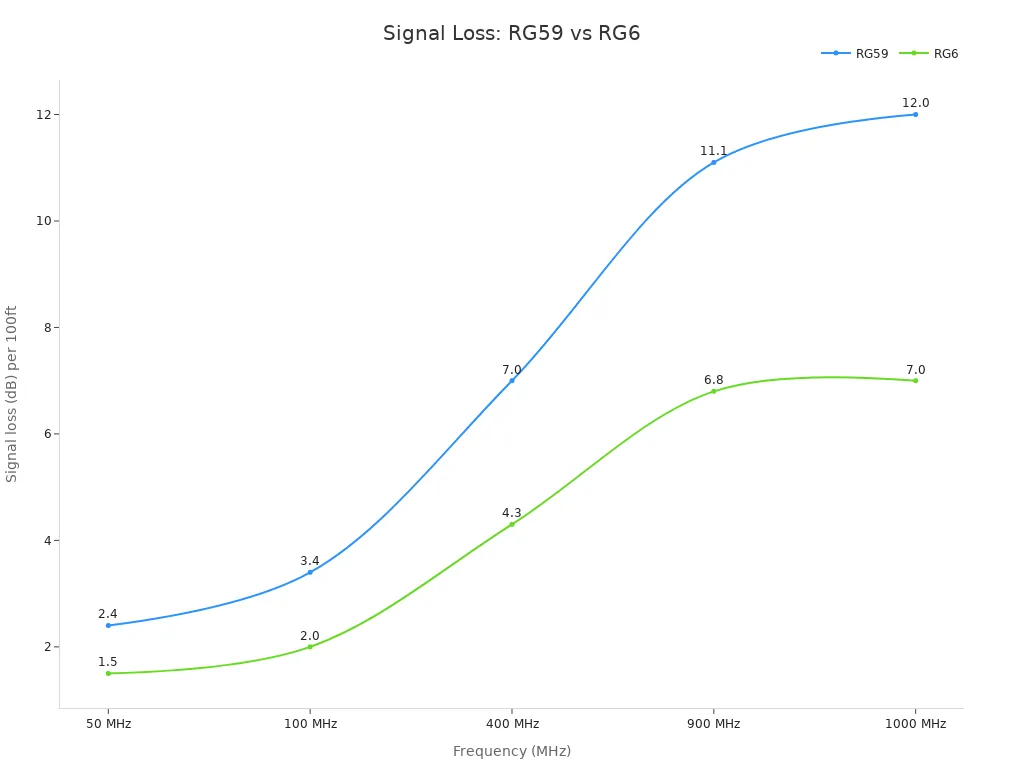
Rg6 features thicker insulation and better shielding, making it suitable for high-speed, high-bandwidth applications. Rg59 experiences more signal loss and fits lower-bandwidth CCTV systems.
Flexible Coaxial Cable for Telecom
Flexible rg coaxial cable plays a vital role in telecom networks. Stranded conductors provide greater flexibility, which is essential for installations in tight spaces. The table below highlights the differences between solid and stranded conductors:
| Type of Cable | Flexibility | Performance |
|---|---|---|
| Solid | Less flexible, suitable for fixed installations | Better electrical performance, reduced signal loss |
| Stranded | More flexible, ideal for frequent movement | Slightly lower performance due to increased resistance and interference |
Flexible rg coaxial cable offers enhanced signal integrity, uniform impedance, and improved shield quality. These features support base stations, broadband, and data transmission, ensuring reliable communication in dynamic environments.
Applications in CCTV and Telecom Networks
Flexible RG Coaxial Cable in CCTV Systems
Flexible coaxial cables play a critical role in cctv applications. These cables support reliable video transmission, which is essential for security camera systems. RG59 is the most common type used in cctv due to its flexibility and ease of installation. Installers often select RG59 for short-distance video transmission, especially in analog cctv setups. The flexibility of these cables allows for efficient routing through walls and ceilings, reducing labor time and minimizing disruptions during installation.
Key applications of flexible coaxial cables in cctv include:
• Video transmission from cameras to digital video recorders (DVRs)
• Integration with cctv camera power supplies using Siamese coaxial cables
• Upgrading legacy analog systems to support HD video formats
• Connecting cameras in complex environments, such as retail stores and office buildings
Siamese coaxial cables combine RG59 with an 18-gauge power wire in a single jacket. This configuration simplifies cctv installations by allowing both power and video to run together. It reduces the need for separate wiring, which lowers interference and ensures consistent power delivery to cameras. This integration is vital for maintaining video quality and system reliability in cctv applications.
The choice of connectors also impacts installation and maintenance in cctv. The table below summarizes the most common connector types and their effects:
| Connector Type | Application | Impact on Installation and Maintenance |
|---|---|---|
| BNC | RG59 | Common in analog cctv, requires proper termination for signal integrity |
| RCA | RG59 | Used in older AV systems, less common in modern installations |
| F-type | RG6 | Preferred for high-frequency signals, ensures strong connections |
| Crimp | General | Fast and reliable, suitable for most installations |
| Compression | General | Best for shielding and weather resistance, recommended for long-term use |
| Twist-on | General | Low-cost, not ideal for high-frequency applications |
Flexible coaxial cables ensure consistent video quality and reliability in cctv applications. Their adaptability makes them a cost-effective choice for cctv, especially in environments where cable runs must navigate tight spaces or frequent bends.
Flexible Coaxial Cable in Telecom Networks
Telecom networks rely on flexible coaxial cables for a wide range of applications. These cables connect antennas, cellular repeaters, and base stations, forming the backbone of wireless communication systems. The shielding and low signal loss of coaxial cables are essential for maintaining reliable connections in modern telecom networks, including 5G and IoT deployments. Flexible coaxial cables support high-speed data transmission, which is critical for broadband and data services in both urban and remote areas.
Flexible coaxial cables offer low signal loss and high power handling capacity. These features are crucial for effective communication in base station and broadband deployments. The mechanical properties of these cables ensure durability and reliability, making them suitable for outdoor and high-power RF applications. Telsto Feeder Cable stands out as a dependable solution for telecom applications, providing consistent performance in challenging environments.
The table below highlights real-world applications of flexible coaxial cables:
| Application Area | Description |
|---|---|
| Telecommunications | Used by large cable companies to provide reliable connectivity and high-quality service delivery. |
| Security and Surveillance | Employed to transmit video feeds over long distances for monitoring large structures like malls. |
Flexible coaxial cables enable long-distance signal transmission, which is vital for telecom infrastructure. Their use in base stations and broadband networks demonstrates their importance in supporting modern communication needs.
Practical Tips and Alternatives
Selecting the right coaxial cable for cctv and telecom applications requires careful consideration of several factors. Attenuation, conductor size, shielding type, and frequency support all influence cable performance. The table below compares common coaxial cable types:
| Coax Type | Conductor Size | Shield Type | Frequency Support | Max Length (Typical) |
|---|---|---|---|---|
| RG59 | 20AWG | Braided (60%) | Up to 500MHz | 750 feet (229m) |
| RG6 | 18AWG | Braided + Foil | Up to 1GHz | 1,000 feet (305m) |
| RG11 | 14AWG | Double Braided + Foil | Up to 3GHz | 1,500 feet (457m) |
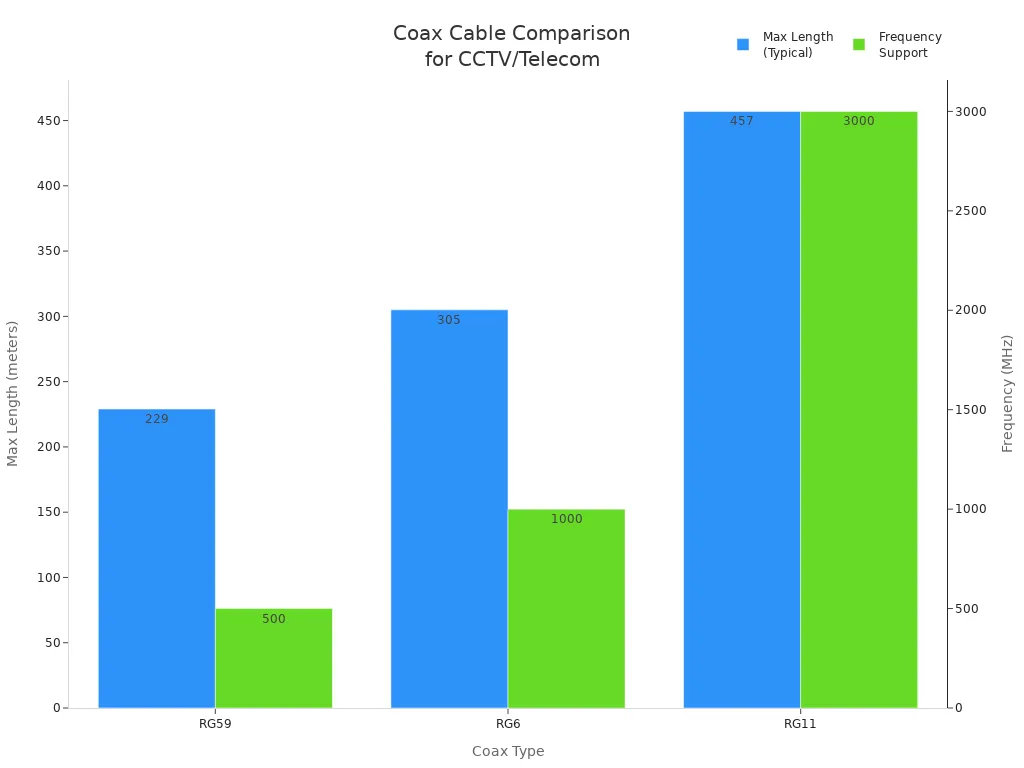
Thicker conductors reduce attenuation, while advanced shielding minimizes signal loss from interference. RG11 is preferred for long runs, while RG6 and RG59 are suitable for shorter distances and lower-frequency cctv applications.
When comparing coaxial cables to alternatives like fiber optic, several practical considerations arise:
• Installation cost for coaxial cable ranges from $0.30 to $1.50 per foot, while fiber optic cable costs between $0.50 and $3.00 per foot.
• Coaxial cable requires less training and simpler tools for installation, making it accessible for most technicians.
• Fiber optic cables deliver superior bandwidth, distance, and reliability, but require specialized skills and higher initial investment.
• Coaxial cable often uses existing wiring, reducing capital costs for upgrades in cctv and telecom applications.
Cat5 cable is another alternative, especially in large-scale cctv systems. Cat5 can carry data, power, and video in one cable, simplifying installation and reducing complexity. For systems with more than 16 cameras, Cat5 becomes more efficient than traditional coaxial solutions.
For both cctv and telecom applications, Telsto Feeder Cable provides a high-quality, reliable option. Its robust construction and excellent electrical characteristics make it suitable for demanding environments, ensuring optimal transmission and system performance.
Tip: Always match the cable type to the application's distance, frequency, and installation environment. This ensures the best balance of performance, reliability, and cost.
Selecting the right flexible RG coaxial cable ensures optimal performance in CCTV and telecom systems.
• Consider signal requirements, environmental conditions, handling, fire protection, ingress protection, and certifications.
• Follow best practices: use proper cable selection, observe bend radius, inspect regularly, and protect from UV and moisture.
High-quality options like Telsto Feeder Cable deliver strong signal clarity, robust shielding, and extended lifespan for reliable network operation.
FAQ
What is the main advantage of using flexible RG coaxial cables in CCTV installations?
Flexible RG coaxial cables simplify routing through tight spaces. They reduce installation time and maintain signal integrity for reliable video transmission.
How does Telsto Feeder Cable perform in outdoor telecom environments?
Telsto Feeder Cable uses high-grade materials. It resists moisture and extreme temperatures, ensuring consistent signal transmission in outdoor telecom applications.
Can RG coaxial cables support HD video formats in modern CCTV systems?
Yes. RG59 and RG6 coaxial cables support HD video formats. Proper shielding and connectors help maintain high-quality video signals.
Post time: Jun-16-2026


